What Salesforce Field Service Actually Does (Beyond the Feature List)

Salesforce's own Field Service page reads like most enterprise software marketing — a long list of capabilities, a few keynote clips, and pricing that only starts making sense once you're already talking to a sales rep. If you're a trades or field service business trying to work out what any of it actually means for your day-to-day operation, that's not much to go on.
We run Field Service Lightning (FSL) inside a real trades business every day, so here's the practical version — what these capabilities actually do, and where they matter most.
Autonomous scheduling — what it replaces, not just what it adds
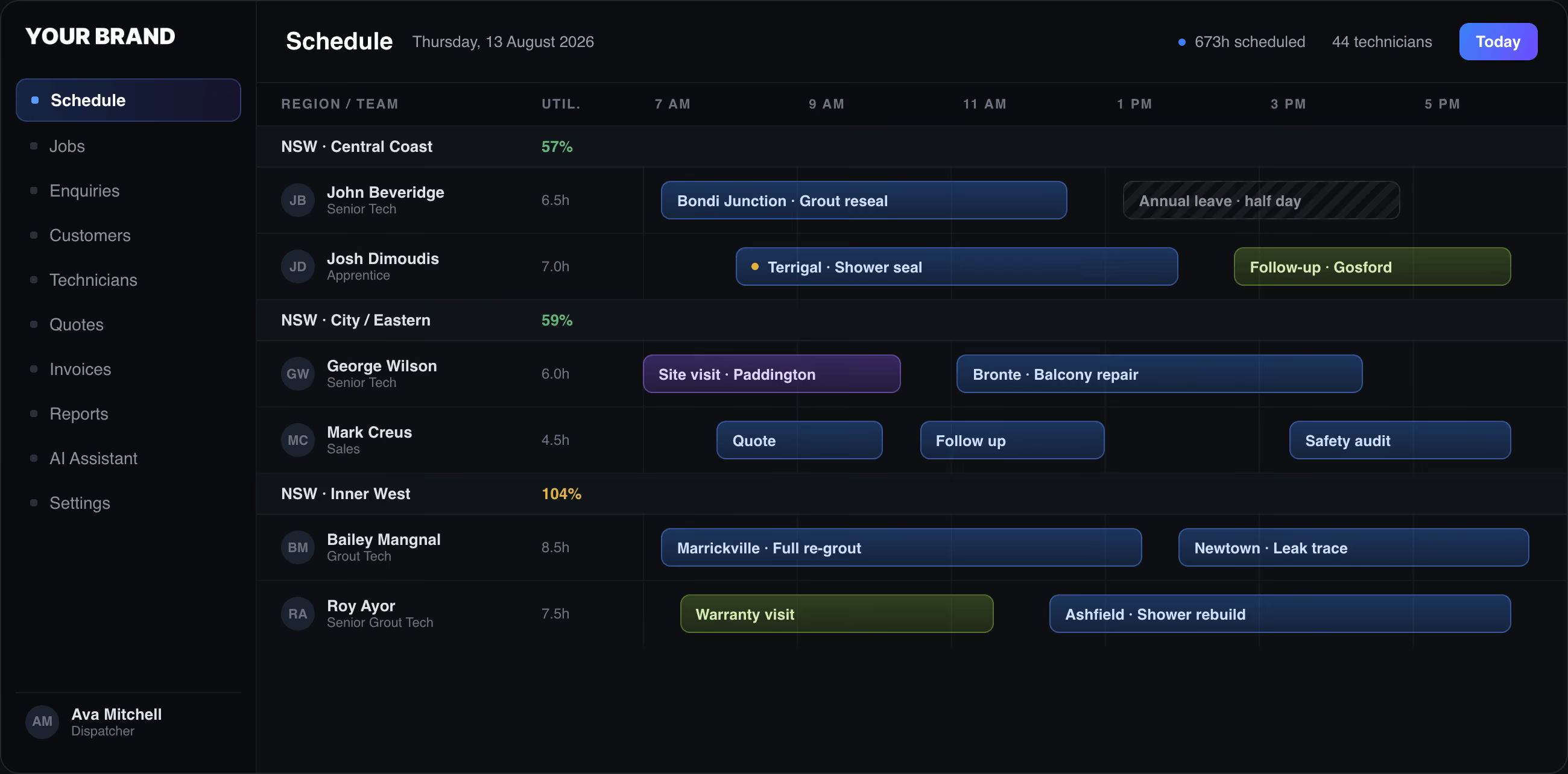
Salesforce describes this as Agentforce managing "every detail — from customer outreach and reshuffling to confirmations." In practice, this is the difference between a dispatcher manually slotting every job into a calendar and a system that fills gaps, reschedules around cancellations, and confirms appointments without a human touching each one.
The number that matters here isn't a feature — it's what it does to your dispatcher-to-technician ratio. Most trades businesses running manual or semi-manual scheduling plateau somewhere around 1:8 to 1:12. With proactive, AI-driven scheduling actually doing the reshuffling instead of a person, that ratio can move dramatically — we've seen it move from around 1:4 to 1:25+ in our own operation, with no increase in dispatch headcount.
The dispatcher console — less about visibility, more about decision speed
Salesforce's dispatch and resource management tools centralise availability, skill matching, and territory coordination into one console. The marketing framing is "unified workspace." The practical framing is: a dispatcher stops toggling between systems to answer "who's free, who's qualified, and who's closest" and gets the answer in one place, instantly.
For a multi-location trades business, this matters more than it sounds — coordinating crews across states or regions without a single source of truth is exactly where scheduling chaos tends to start.
Offline-first mobile — built for people who aren't always online
Field technicians work in basements, regional areas, and buildings with no signal. Salesforce's mobile app is built offline-first, syncing the moment connectivity returns rather than requiring it constantly. This sounds minor until you've had a technician unable to update a job status or pull a customer's service history because a signal dropped mid-appointment.
Asset service management — the shift from reactive to proactive
Rather than waiting for something to break, asset tracking lets a business schedule maintenance based on actual usage or condition data — Salesforce's example is triggering service when an asset's temperature crosses a threshold. For trades businesses managing recurring service relationships rather than one-off jobs, this is the mechanism that turns a business from "we come when you call" into "we're already booked before it fails."
Work order management and voice dictation — where the real time savings hide
This is the least glamorous part of the platform and often the highest-impact. Manual work-order entry, PDF parsing, and paperwork are where trades businesses lose enormous amounts of time that never shows up as a single dramatic problem — it's death by a thousand cuts. Voice dictation and AI-powered document processing directly attack that. We've taken work-order entry that used to take roughly two business days down to about 15 seconds through automated parsing — not by working faster, but by removing the manual step almost entirely.
Operations Home and field service intelligence — decisions instead of dashboards
Salesforce's Operations Home layer (powered by Tableau Next) lets teams ask plain-language questions about their own operational data rather than digging through static reports. The practical value isn't the novelty of asking a question in natural language — it's that the person who needs an answer (why did first-time-fix rates drop in one region last month?) can get it without waiting on someone else to build a report.
Where this actually lands, in numbers
Salesforce cites industry-wide figures from its own Field Service Success Metrics Study: a 31% increase in first-time-fix rate, 32% increase in mobile worker productivity, 26% decrease in truck rolls, and 27% decrease in new employee ramp-up time. Those are believable directionally — they track with what removing manual triage and giving technicians better on-site information tends to produce in any operation.
What we can speak to directly is our own numbers, from running this inside The Grout Guy, Australia's largest tile and grout restoration network, at 150+ technicians across six states and more than 50,000 jobs a year: a dispatcher ratio that moved from 1:4 to 1:25+, and work-order processing cut from days to seconds. Those aren't projections from a vendor study — they're what happened inside a real national operation.
The gap between "Salesforce has this" and "this works for a trades business"
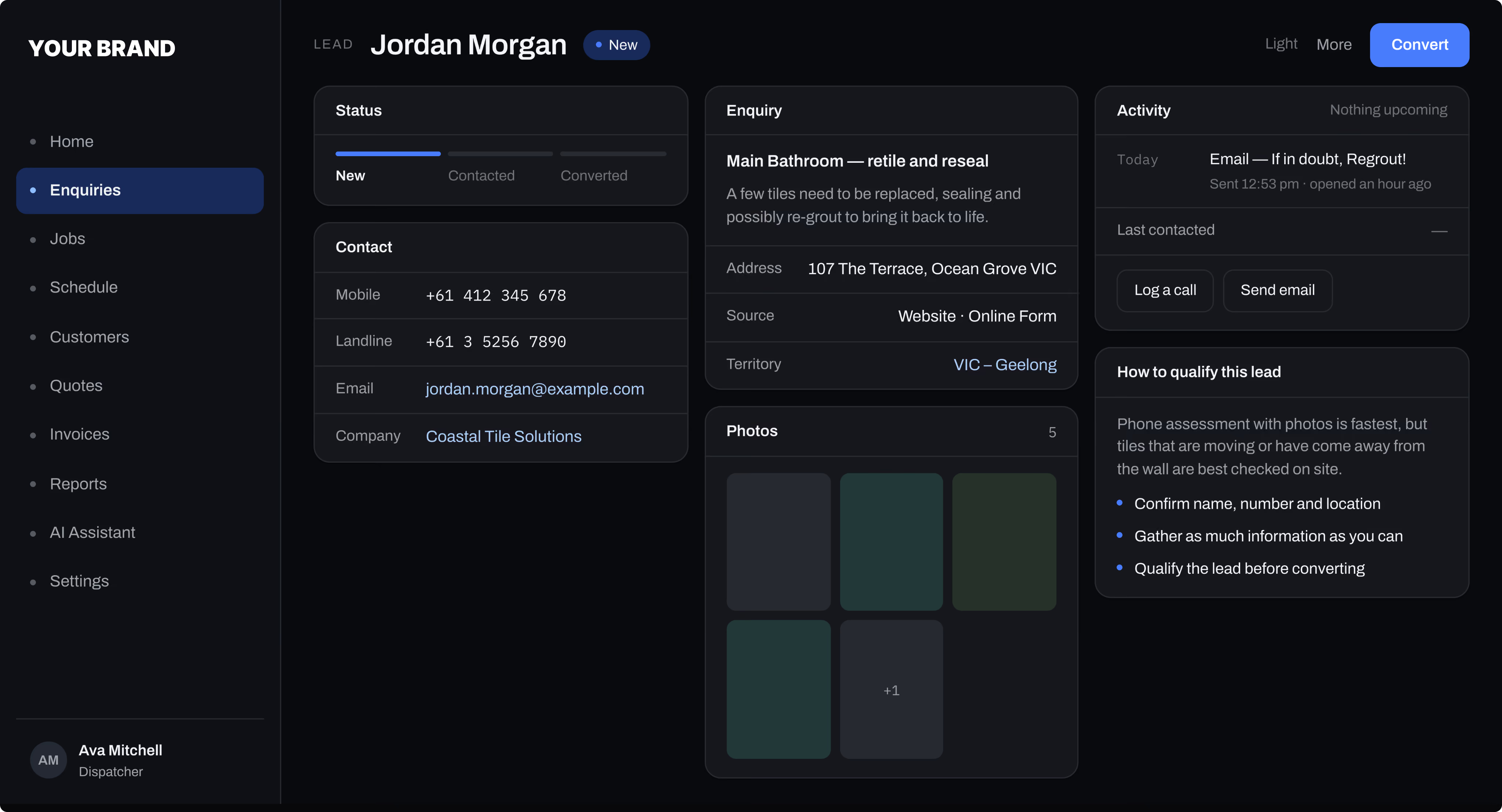
Here's the part the feature list doesn't tell you: Field Service Lightning is a genuinely capable platform, but it isn't trades-specific out of the box. Every capability above needs to be configured around how a trades business actually operates — job types, technician skill sets, regional service areas, customer communication style — before it does any of what's described here. That configuration work is the difference between "we have Salesforce" and "Salesforce is actually running our operation."
That's the layer Servly builds. We're not describing FSL's capabilities from a marketing page — we've configured them inside a real trades business, and we know which parts of the platform actually move the numbers that matter versus which parts are impressive in a demo and irrelevant on a job site.
Servly is an authorised Salesforce Outsourced Service Provider (OSP) building Field Service platforms for Australian trade and field service businesses, proven first inside The Grout Guy's own national operation. Get in touch if you want to know which parts of this actually matter for your business.
Explore more blogs