Tradify vs Servly: when a growing trade business needs more
Last updated: November 2026
The short version
Tradify is the better choice for a small crew that wants to be quoting and invoicing this week. Servly makes sense once you are heading past about 15 people and need scheduling, reporting and CRM that a simple app was never meant to provide.
We make Servly, so we have a stake in this comparison. We have tried to be fair about where Tradify is the better choice.
Different tools for different stages
Tradify and Servly are not really competing for the same business. Tradify is built for owner-operators and small crews. Servly is built for trade businesses that have grown past that.
So this is less a head-to-head and more a guide to knowing which stage you are in.
What Tradify does well
- It is easy. Tradify is known for fast setup and a clean interface. Most small teams are running within days.
- The whole loop in one app. Enquiry, quote, schedule, timesheet, invoice and payment are all covered.
- Clear pricing. Plans are A$48, A$52 and A$62 per user per month ex GST, month to month, with a 14-day free trial. There is also a custom tier for large teams.
- Compliance. SWMS, JSA and trade compliance certificates are built in and kept current for Australia and New Zealand.
- Accounting. It syncs with Xero, MYOB and QuickBooks Online.
If you are a sparky with two apprentices, Tradify is a sensible choice. Servly would be too much system for you.
Where Tradify runs out
Tradify stays simple by leaving things out. That is a fair trade for a small team, and it becomes a constraint for a bigger one.
- Per-user cost adds up. Every login is a paid seat. A team of 15 on the top plan is about A$930 a month ex GST.
- Reporting sits on the top plan. Reporting, purchase orders and the AI tools are only on Plus, and the reporting is still light.
- Manual scheduling. Scheduling is a drag-and-drop calendar. Tradify does not advertise route optimisation or automated dispatch.
- It needs signal. The mobile app requires a live connection and does not sync offline.
- No public API. Tradify has native integrations for accounting, payments and calendar. It does not have a public, self-service API for building your own connections to a CRM, marketing tool or data warehouse.
What Servly does differently
Servly is a packaged product on Salesforce Field Service, built from the operating model behind The Grout Guy, where the same platform runs more than 150 technicians across Australia. It is separate from The Grout Guy's own setup, and we say below what is not in the package.
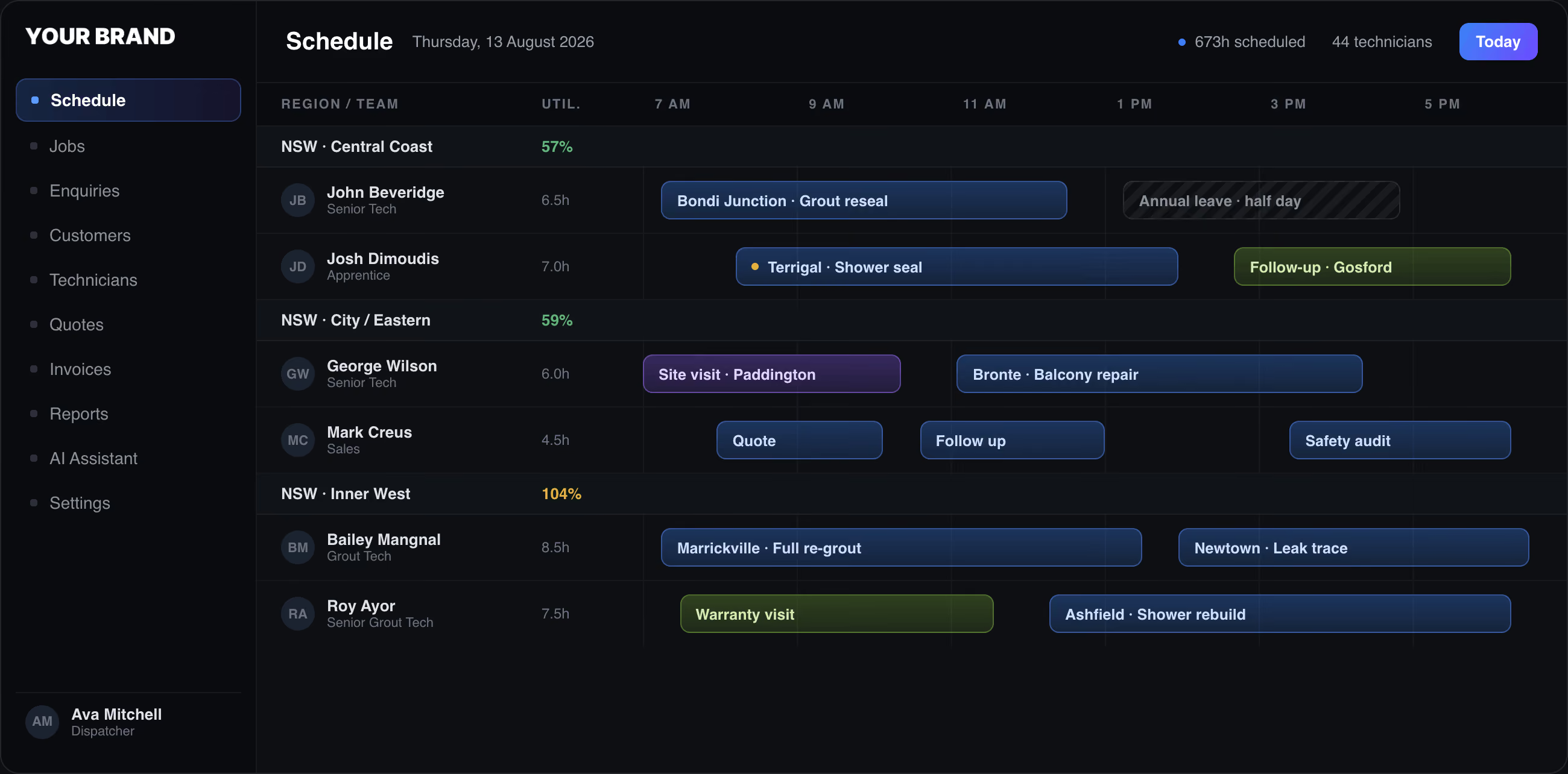
- Scheduling that plans the day. The scheduling engine accounts for territory, skills and travel time, not just who is free.
- Works without signal. The Salesforce Field Service mobile app is built to work offline and sync when coverage returns.
- Reporting as standard. Dashboards by job, crew, territory and customer, built on live data.
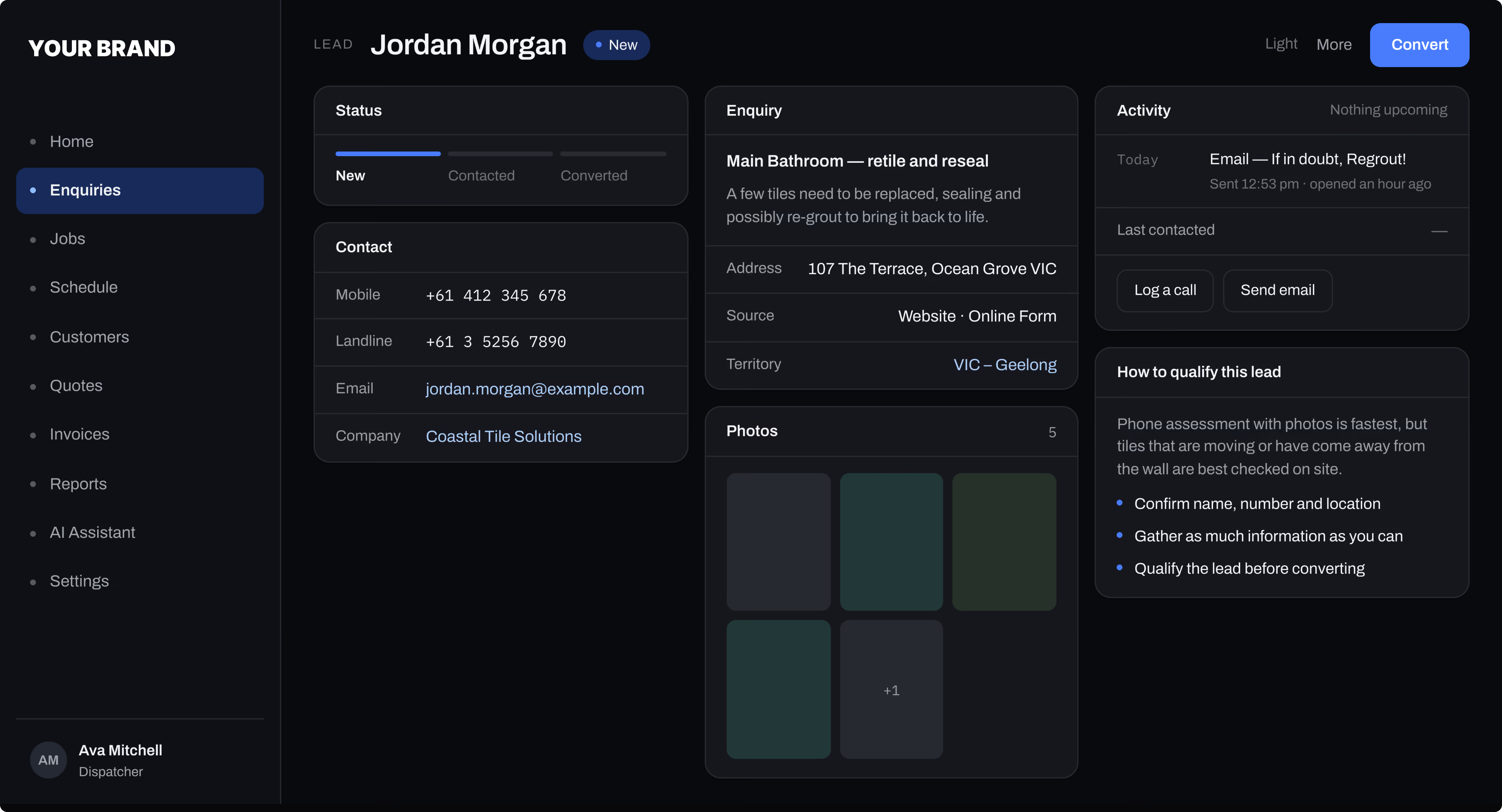
- Sales and service together. Leads, quotes, jobs and customer history sit in one CRM.
- An open platform. Salesforce connects to a wide range of other systems, so your job data is not locked in one app.
Most job apps are built by software companies working out how trades operate. Servly was built the other way round, by a trade business that needed it. Servly is an authorised Salesforce provider, and The Grout Guy's build has been recognised by Salesforce with a customer success award. The result is an enterprise platform that already fits the way a trade business works.
What changed at The Grout Guy
These are The Grout Guy's own results after moving to Salesforce, as published in Salesforce's customer story. They come from The Grout Guy's own build, which includes AI agents, and are not a promise of what every Servly customer will see.
- Quote conversion increased from the low 30% range to over 50%.
- One dispatcher now supports 20 to 25 technicians, up from six or seven.
- Emailed work orders are processed in about two minutes. They used to take up to two days.
- The field team grew from 30 to 130 technicians in three years, and is past 150 today.
What Servly does not cover yet
Servly is built for service-led trades first. We started with scheduling, sales and customer experience, and some things are not packaged yet.
- Compliance certificates. Tradify's built-in certificate library is a real strength. Trade compliance forms are in development at Servly.
- Accounting. Servly integrates with Xero today, and MYOB is planned. Tradify already supports MYOB and QuickBooks Online.
- Assets and maintenance. Neither product offers this out of the box today. The difference is that Salesforce Field Service already includes asset tracking and maintenance plans in the platform, so for Servly it is a matter of packaging, not a missing foundation.
If one of these decides it for you, tell us what you need. Early customers are shaping what we build next.
Side by side
| Tradify | Servly | |
|---|---|---|
| Best for | Small crews, mostly domestic work | Growing teams and multi-territory operators |
| Pricing | A$48 to A$62 per user per month ex GST, custom tier for large teams | Monthly plan by team size, Salesforce licence included |
| Setup | Self-serve, 14-day free trial | Guided setup with a one-off fee |
| Scheduling | Drag-and-drop calendar | Field Service scheduling with territories, skills and travel |
| Mobile offline | No offline sync | Salesforce Field Service mobile app, built for offline use |
| Reporting | Top plan only | Custom reports and dashboards |
| Open API | No public API | Salesforce platform APIs |
| Compliance forms | Built-in SWMS, JSA and certificates | In development |
| Accounting | Xero, MYOB, QuickBooks Online | Xero today, MYOB planned |
Tradify details are from its public pricing and feature pages as at November 2026.
Signs you have outgrown Tradify
- You have more than about 15 people and scheduling takes someone most of their day.
- You cannot say which jobs, crews or suburbs make you money.
- Your techs work in basements, plant rooms or regional areas and lose the app.
- You are taking on commercial clients who send work orders and expect reporting.
- You want your job system to talk to your marketing or your CRM, and it cannot.
One or two of these is normal. Four or five means the tool is holding the business back.
Which should you choose?
Choose Tradify if you are a small crew that wants to quote, schedule and invoice with minimal fuss, and you rely on its built-in compliance certificates.
Look at Servly if growth is the plan and you would rather change systems once than twice.
Common questions
Is Servly the same system The Grout Guy runs?
No. Servly is a packaged product built from the same operating model. The Grout Guy's own setup includes extra Salesforce products and custom AI agents that are not part of the standard package.
Do I need to buy Salesforce separately?
No. The Salesforce licence is included in your Servly plan.
Do I need a Salesforce administrator?
Servly manages the platform for you. Day-to-day business settings are handled through a settings screen built for owners and office staff.
Can I bring my Tradify data across?
Usually, yes. Tradify has no public API, so data comes out through its exports and your accounting system. What comes across depends on your setup and data quality, so we assess that with you first.
What does Servly cost?
More than Tradify for a small team. Plans are priced by team size with a one-off setup fee. Ask us for pricing for your team.
Not sure which stage you are in?
Explore more blogs