ServiceM8 vs Servly: which fits a growing trade business
Last updated: November 2026
The short version
ServiceM8 is the better choice for a small crew that wants low cost and a fast start. Servly is for the business that has outgrown job management software and needs scheduling, sales and reporting on one platform. We made that move ourselves.
We make Servly, so we have a stake in this comparison. We have tried to be fair about where ServiceM8 is the better choice.
We used to run on ServiceM8
We should say this up front. The Grout Guy, the business Servly came out of, ran on ServiceM8 for years. It got us a long way.
ServiceM8 is a good product. It is Australian, it is affordable, and a tradie can learn it in an afternoon. If you run a crew of five and want to stop losing paperwork, it is probably the right answer and you can stop reading here.
This post is for the business that is starting to feel the edges.
What ServiceM8 does well
- Pricing. ServiceM8 charges by job volume, not by user. Plans run from A$29 to A$349 a month including GST, with unlimited users on every paid plan.
- The phone experience. Scheduling, quoting, invoicing and payment all work from the app, and the iPhone version is one of the best in the market.
- Accounting. It syncs with Xero, MYOB and QuickBooks Online.
- Forms. The Form Store has more than 250 ready-made forms, some of them paid, including electrical and gas compliance certificates.
- AI. ServiceM8 has an AI office assistant and its own phone system, which is more than most small-business tools offer.
For a small crew, that is hard to beat. We would not try to.
Where growing businesses hit the ceiling
Our own trigger was volume. As The Grout Guy grew across states, invoices stopped syncing cleanly and line items went missing. That meant billing errors, and billing errors land on the customer.
That was our experience at our scale, and yours may differ. But the pattern we hear from other operators is similar:
- Reporting. ServiceM8 has job, productivity and revenue reports, and for many businesses that is enough. Reporting across several states, entities and sales channels is where a job system tends to run short of a CRM platform.
- Sales. It tracks jobs and clients well. It is not built to run a sales pipeline, manage commercial accounts or track where your leads come from.
- Structure. It is designed for one business with one team. Multiple states, divisions or entities take workarounds.
- Job allowances. Unlimited users does not mean unlimited jobs. Each plan has a monthly job allowance, so the cost steps up as volume grows.
None of these matter at five people. Most of them matter at thirty.
What Servly does differently
Servly is built from the operating model that took The Grout Guy from ServiceM8 to a national field team. It is a separate, packaged product on Salesforce Field Service, the platform that now schedules more than 150 of our technicians across Australia. Not everything in The Grout Guy's own setup is in the Servly package, and we say below what is not.
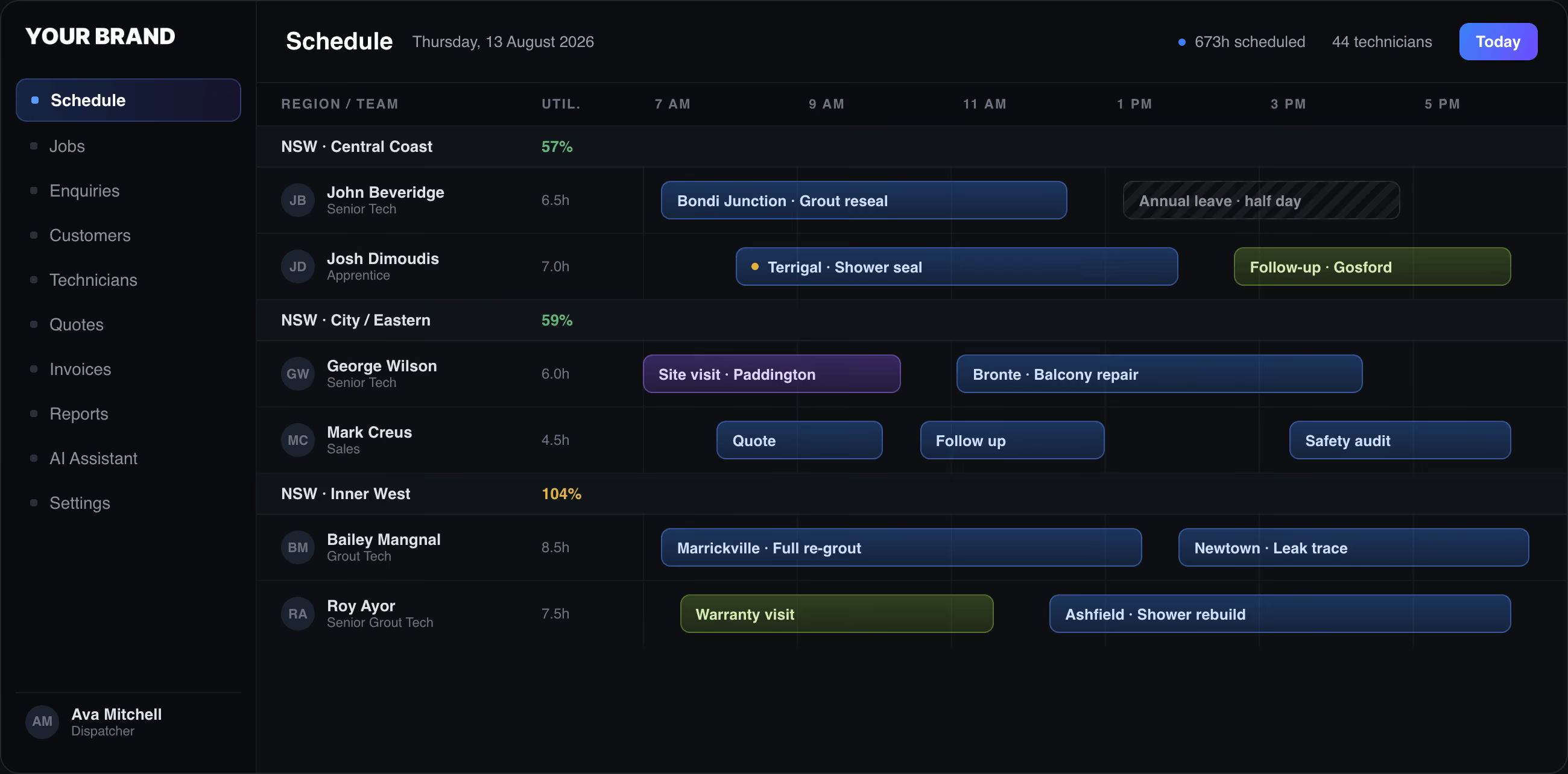
- Scheduling built for scale. Territories, skills and travel time are part of the scheduling engine, so a small scheduling team can run a large field team.
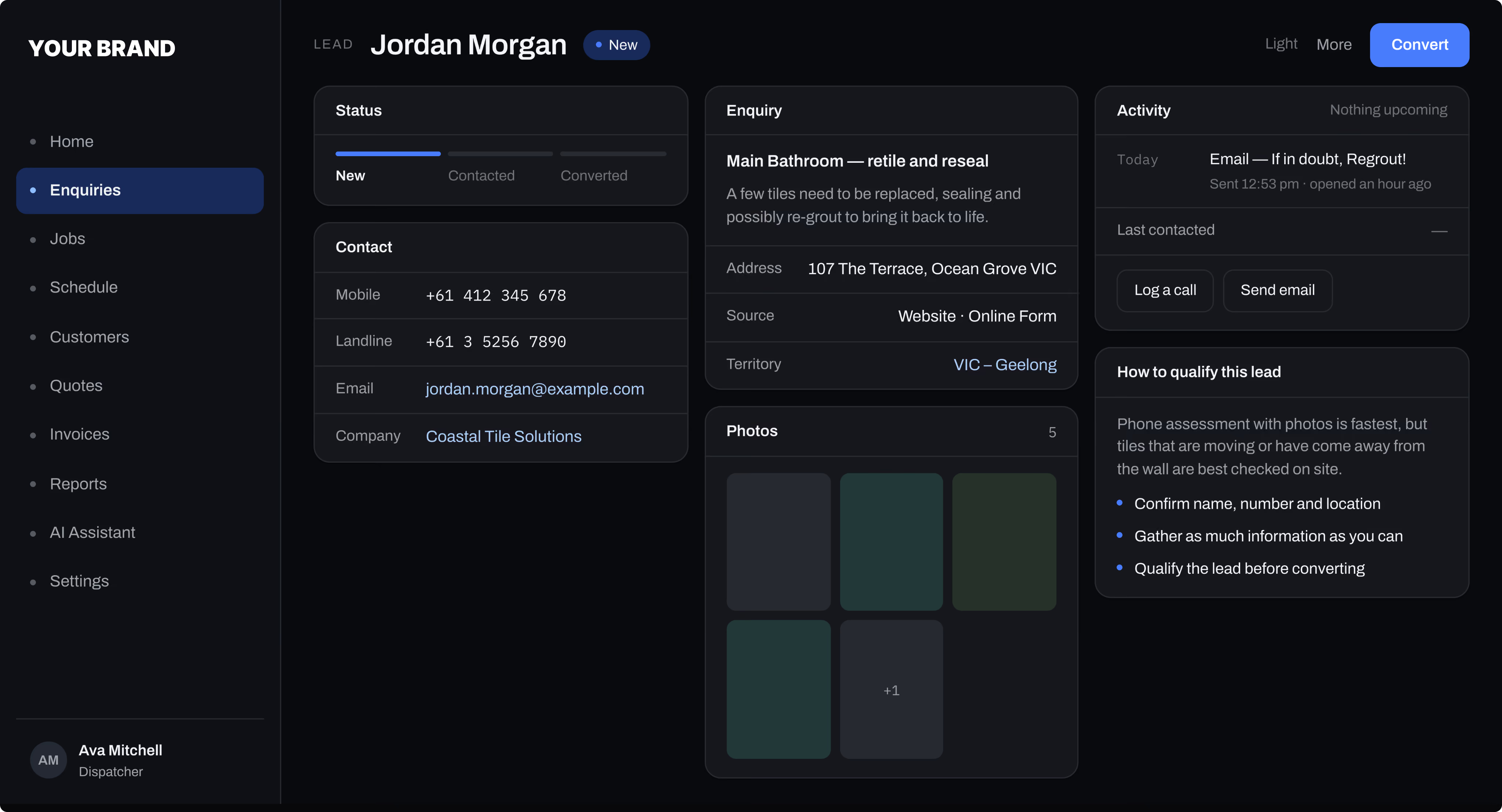
- A real CRM. Leads, quotes, accounts and jobs sit in one place, so you can see the whole history of a customer and the whole pipeline of work.
- Reporting you do not export. Dashboards and reports are built on your live data, by job, crew, territory or customer.
- Emailed work orders, joined to the CRM. ServiceM8's inbox can pre-fill a job card from an emailed work order. In Servly the work order also lands against the customer's account, so its history, follow-up and reporting sit in the CRM with everything else.
- Room to grow. Add a state, a division or a new line of work without changing systems again.
This is the step up we wanted when we outgrew ServiceM8, and it did not exist, so we built it. Servly is an authorised Salesforce provider, and The Grout Guy's build has been recognised by Salesforce with a customer success award. You get a platform used by some of the largest companies in the world, already shaped around a trade business by people who run one.
What changed at The Grout Guy
These are The Grout Guy's own results after moving to Salesforce, as published in Salesforce's customer story. They come from The Grout Guy's own build, which includes AI agents, and are not a promise of what every Servly customer will see.
- Quote conversion increased from the low 30% range to over 50%.
- One dispatcher now supports 20 to 25 technicians, up from six or seven.
- Emailed work orders are processed in about two minutes. They used to take up to two days.
- The field team grew from 30 to 130 technicians in three years, and is past 150 today.
What Servly does not cover yet
Servly is built for service-led trades first: businesses that win on response, scheduling and customer experience. That is a deliberate starting point, and it means a few things are not packaged yet.
- Accounting. Servly integrates with Xero today, and MYOB is planned. If you need MYOB now, ServiceM8 has you covered.
- Compliance forms. ServiceM8's form library is ahead of ours. Trade compliance forms are in development.
- Stock and assets. Salesforce Field Service includes inventory, asset tracking and maintenance plans as part of the platform. Servly has not packaged them for trades yet, but the capability is underneath, not something to be invented.
If one of these is the thing stopping you, tell us. Early customers are shaping what we build next.
Side by side
| ServiceM8 | Servly | |
|---|---|---|
| Best for | Sole traders and small crews | Growing teams and multi-territory operators |
| Pricing | By job volume, unlimited users, A$29 to A$349 a month | Monthly plan by team size, Salesforce licence included |
| Setup | Self-serve, 14-day free trial | Guided setup with a one-off fee |
| Scheduling | Drag-and-drop schedule, one-click routing | Field Service scheduling with territories and skills |
| CRM | Client and job history | Full Salesforce CRM with leads and pipeline |
| Reporting | Job, productivity and revenue reports | Custom reports and dashboards |
| Accounting | Xero, MYOB, QuickBooks Online | Xero today, MYOB planned |
| AI | Office Agent, plus ServiceM8 Phone | Agentforce agents, as an add-on |
ServiceM8 details are from its public pricing and feature pages as at November 2026.
Which should you choose?
Choose ServiceM8 if you have a small crew, mostly domestic work, and you want something cheap that works today. You use MYOB and do not want to change.
Look at Servly if you are past about 15 staff, working across regions, taking on commercial work, or making decisions from spreadsheets because your job system cannot tell you what you need.
Servly costs more than ServiceM8. It should. The question is what the gaps are costing you now.
Common questions
Is Servly the same system The Grout Guy runs?
No. Servly is a packaged product built from the same operating model. The Grout Guy's own setup includes extra Salesforce products and custom AI agents that are not part of the standard package.
Do I need to buy Salesforce separately?
No. The Salesforce licence is included in your Servly plan.
Do I need a Salesforce administrator?
Servly manages the platform for you. Day-to-day business settings are handled through a settings screen built for owners and office staff.
Can I bring my ServiceM8 data across?
Usually, yes. ServiceM8 has an API, and we have moved a live business off it ourselves. What comes across depends on your setup and data quality, so we assess that with you first.
What does Servly cost?
More than ServiceM8. Plans are priced by team size with a one-off setup fee. Ask us for pricing for your team.
Moving from ServiceM8
We have done this migration ourselves, including the rough parts.
Explore more blogs