Best Field Service Management Software for Growing Australian Trade Businesses (2027)

Last updated: November 2026
The short answer
There is no single best field service management (FSM) platform for Australian trades. The right one depends mostly on team size and how complex your work is.
- Sole trader to about 10 staff, mostly reactive domestic work: ServiceM8 or Tradify. They're simple, affordable and quick to set up.
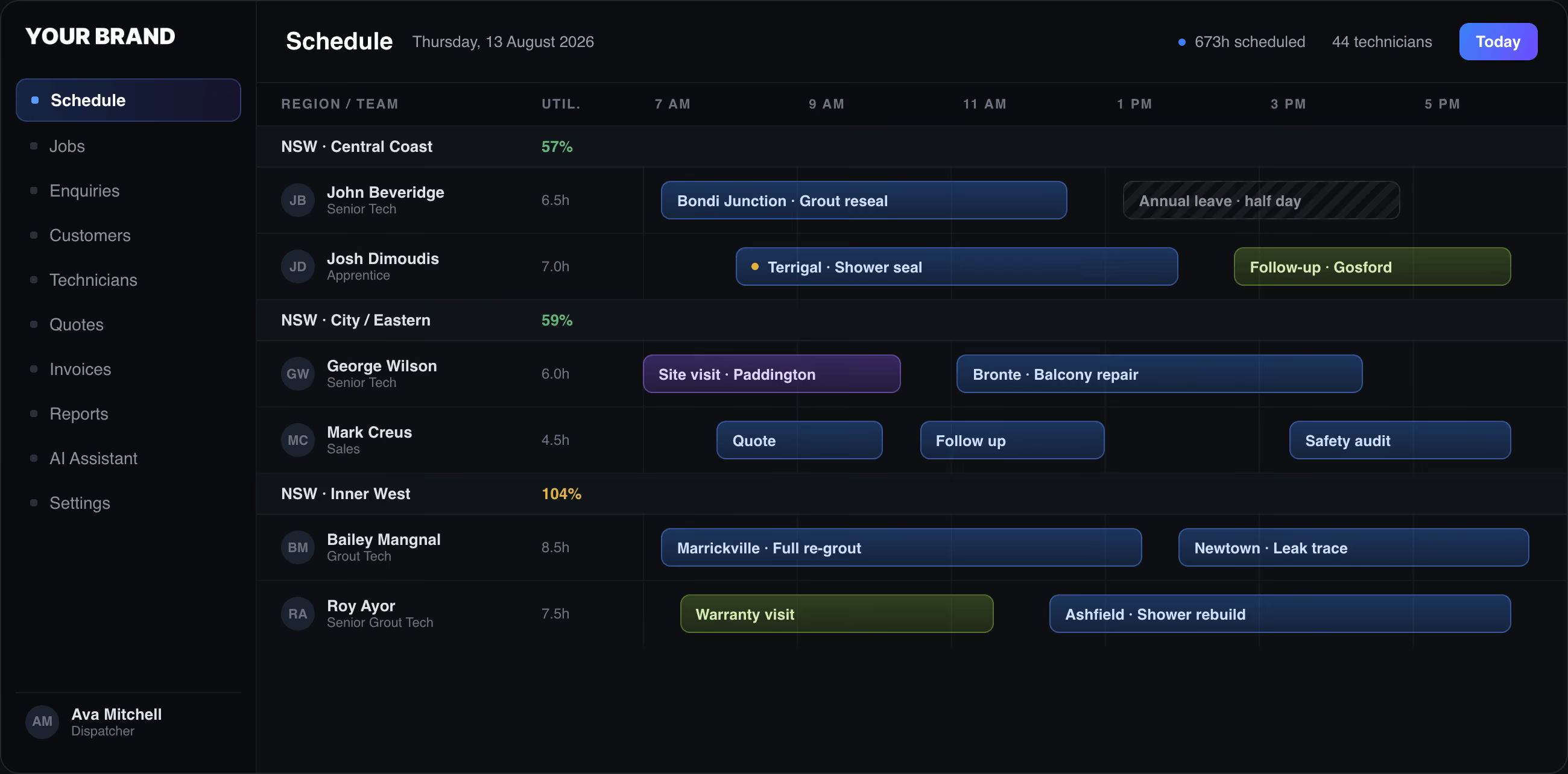
- Growing businesses from a few staff to 50+ and multi-site operations: Servly. CRM, scheduling, field work and reporting on one platform that doesn't need replacing as you grow.
- Worth a look in specific niches: Jobber for small home-service crews (with Australian feature gaps), AroFlo for compliance-heavy trades that live on supplier catalogues, Simpro for project-heavy multi-trade contractors, and ServiceTitan for residential HVAC and plumbing shops that want its pricebook and membership tooling.
We built Servly, so we have a stake in this. We've tried to be straight about where each tool fits, including where Servly isn't the right choice. Pricing and features are as of November 2026.
At a glance
| Platform | Best for | Team size | Pricing (Nov 2026) | Setup effort | Main limitation |
|---|---|---|---|---|---|
| ServiceM8 | Small crews wanting a strong iPhone app and unlimited users | 1 to about 10 to 15 staff | A$29 to A$349/mo by job volume, unlimited users (inc GST) | Low | Basic reporting; chat-only support |
| Tradify | Owner-operators wanting the simplest setup | 1 to about 10 to 15 staff | A$48 to A$62 per user/mo (ex GST) | Very low | No public API, no offline mode; reporting only on top plan |
| Jobber | Home-service crews wanting polished quoting and client portal | 1 to about 15 users | US$29 to US$699/mo by team band (USD) | Low | Two-way SMS, Jobber Payments and AI Receptionist not available in Australia; one-way Xero sync |
| AroFlo | Compliance-heavy service trades with stock and assets | 3 to 50 staff | From A$80 per user/mo, 3-user minimum, plus A$1,450 to A$2,900 setup (ex GST) | Medium to high | Steep learning curve; limited CRM; rigid reporting |
| Simpro | Multi-trade contractors with inventory, projects and maintenance | About 20+ staff | Not published; reported around A$85 to A$100 per person/mo plus setup | High | Multi-year contracts; interface and mobile sync complaints |
| ServiceTitan | Large US-style residential HVAC, plumbing and electrical shops | 20 to 50+ technicians | Not published; reported A$200 to A$500+ per user/mo, 12-month minimum | Very high | Cost and onboarding; Australian localisation still maturing |
| Servly | Any trade or service business past the small-crew stage that wants to grow on one platform | 3 users to 50+ staff and multi-site | Pricing on enquiry; one monthly AUD bill with Salesforce licences included, seats scale up or down | Medium (guided setup) | Newer offering; more setup than plug-and-play apps; not built for sole traders |
Prices are from each vendor's published pricing or, where none is published, third-party reports. Check current pricing with the vendor before you decide.
The platforms in detail
ServiceM8
Australian-built and self-funded since 2009, ServiceM8 charges by job volume with unlimited users on every paid plan. That makes it very affordable for crews of roughly 3 to 15.
- Strengths: a strong field workflow on a phone, mature forms and compliance certificates, and one of the most complete AI line-ups in the small-trade market (AI phone agent, Office Agent, ChatGPT and Claude connectors).
- Limitations: basic reporting, chat and email support only, and costs that creep up through phone, SMS and job caps. Android still lacks some iOS features.
- Outgrowing it looks like: 15 to 50 staff, commercial or multi-site work, and a need for real reporting or a sales pipeline.
Full comparison: ServiceM8 vs Servly
Tradify
New Zealand-founded and owned by The Access Group since 2024, Tradify is the easiest of these to adopt. It covers enquiry to payment for small domestic trades.
- Strengths: fast setup, well-rated human support, a strong ANZ compliance certificate library and good Xero sync.
- Limitations: every login is charged, there's no offline mode and no public API, and reporting, purchase orders and AI sit on the top plan only. No asset or contract maintenance.
- Outgrowing it looks like: more than 10 to 15 staff, recurring maintenance work, or needing profit reporting by job or tech.
Full comparison: Tradify vs Servly
Jobber
Jobber is one of the largest small-business field service platforms globally, with over 100,000 customers, and it ships AI features quickly. In Australia, though, it's a reduced product.
- Strengths: very easy to use, a polished client portal and quoting, an open API, and a fast AI roadmap.
- Limitations in Australia: USD pricing, no two-way SMS, no Jobber Payments, no AI Receptionist, and one-way Xero sync. Reviewers also cite limited customisation, basic reporting and no reliable offline mode.
- Outgrowing it looks like: 15+ users, multi-crew or project work, subcontractors or service agreements.
Full comparison: Jobber vs Servly
AroFlo
Melbourne-built and owned by Simpro since 2021, AroFlo is the ANZ mid-market product for service, maintenance and compliance trades.
- Strengths: deep trade workflows, 600+ connected supplier catalogues, compliance forms with MEA and NECA links, asset registers, offline mode, local support, and a fast-moving AI layer.
- Limitations: a steep learning curve, cost for small teams (3-user minimum plus setup fee), limited CRM, and a closed reporting engine. Salesforce connects through Zapier only.
- Outgrowing it looks like: needing a real sales pipeline, open reporting, or multi-month project and approval workflows.
Full comparison: AroFlo vs Servly
Simpro
Brisbane-built Simpro covers service, project and maintenance work in one system, with strong inventory and job costing. It's now pushing hard on AI.
- Strengths: breadth across service, projects and maintenance, real-time inventory, progress billing, customer and contractor portals, and an aggressive AI roadmap.
- Limitations: no published pricing, setup fees, multi-year auto-renewing contracts, a 15 to 25% uplift for its AI layer, and recurring complaints about the interface, mobile sync and support. Its CRM is new and basic.
- Outgrowing it looks like: fixed workflows holding you back, or needing CRM and marketing on the same platform.
Full comparison: Simpro vs Servly
ServiceTitan
Nasdaq-listed ServiceTitan is the largest trades platform in the world and is strongest with big US residential HVAC, plumbing and electrical shops.
- Strengths: deep pricebook, memberships and tiered estimating, built-in phones, fleet, marketing and payments, and a well-funded AI roadmap.
- Limitations: no published pricing, 12-month minimum terms, implementation that can run to five figures and months of onboarding, and a poor fit below about 15 to 20 technicians. Australian localisation is still maturing: Xero is listed, MYOB isn't.
- Best fit: large residential HVAC, plumbing and electrical shops that want its pricebook, memberships and built-in fintech. For 50+ staff operations outside that core, or that want AUD pricing and a shorter setup, Servly is the alternative.
Full comparison: ServiceTitan vs Servly
Servly
Servly packages Salesforce Field Service for Australian trades. It was built inside The Grout Guy, which runs it across 150+ technicians in six states.
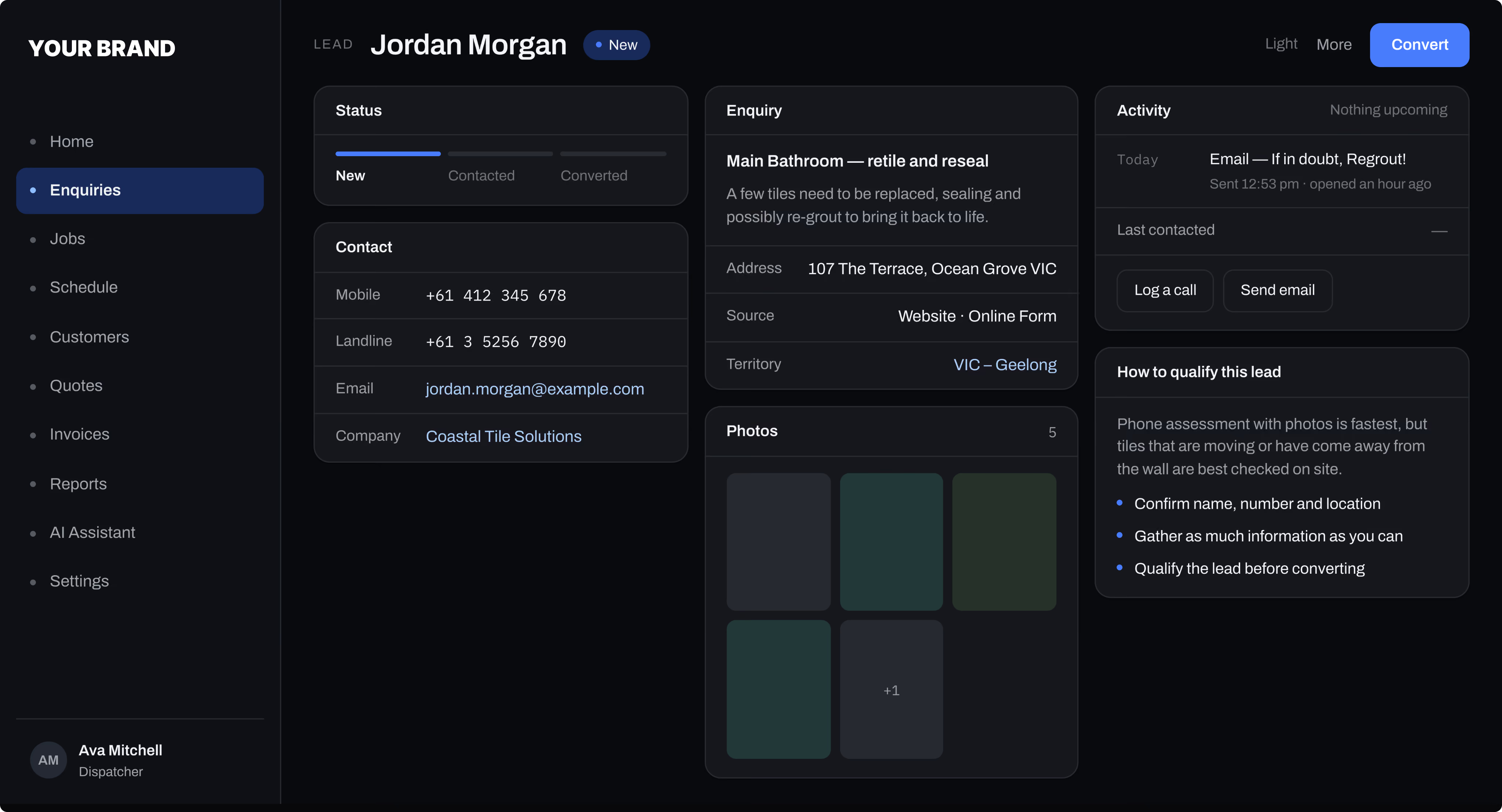
- Strengths: CRM, sales pipeline, field service and reporting on one platform. Offline-capable mobile app, assets and maintenance, two-way SMS and a dedicated number, Xero and Stripe connected, and Salesforce licences included in one monthly bill. A settings app means day-to-day changes don't need a Salesforce admin.
- Limitations: a newer offering with a smaller customer base than the others here. Guided setup takes more effort than a plug-and-play app. It's not built for sole traders. AI agents are an add-on, not included in base plans.
- Best fit: any trade or field service business from about 3 staff upwards, including those weighing up Jobber, AroFlo, Simpro or ServiceTitan. It suits small crews planning to grow as well as established multi-site operators.
- Pricing: plans are on enquiry while they're finalised. You get one monthly bill in AUD covering the software and Salesforce licences, billed monthly, with seats that scale up or down as your team changes.
Book a demo to see how it would fit your business.
How to choose
Start with three questions. They narrow the field faster than any feature list.
- How big will you be in two years, not today? Switching platforms is disruptive. If you're at 8 staff and planning for 25, choose for 25.
- Is your work mostly reactive jobs, or does it include contracts, assets, projects or multiple sites? Simple reactive work for a small crew suits ServiceM8 or Tradify. Once you're past a handful of staff, or doing recurring maintenance, assets or multi-site work, Servly covers it on one platform. AroFlo and Simpro are the trade-specific alternatives.
- Do you need sales and reporting, or just job management? If you want a sales pipeline, marketing and dashboards on the same platform as your jobs, the job-first apps will push you towards extra tools and exports.
Then check the practical details: Australian SMS and payments, Xero or MYOB sync, offline use for techs in poor coverage, contract terms, and what setup actually costs.
FAQ
What is the best field service software for a small Australian trade business?
For 1 to 10 staff doing mostly reactive work, ServiceM8 and Tradify are the strongest options. ServiceM8 suits crews that want unlimited users; Tradify suits owners who want the simplest setup.
What should a 10 to 50 person trade business use?
Servly is built for this stage: CRM, scheduling, field work and reporting on one platform, with Salesforce licences included. AroFlo and Simpro are the trade-specific alternatives, AroFlo for compliance-heavy service work and Simpro for project-heavy multi-trade contractors.
What's the best field service software for a 50+ person trade business?
ServiceTitan and Simpro are the established options, but both come with unpublished pricing, long contracts and heavy implementation. Servly runs at the same scale on Salesforce, the platform behind The Grout Guy's 150+ technicians, with AUD pricing and Salesforce licences included.
Does Jobber work well in Australia?
It works, but with gaps. Two-way SMS, Jobber Payments and the AI Receptionist aren't available here, pricing is in USD, and Xero sync is one way. Servly includes Australian two-way SMS, a dedicated number and Xero, priced in AUD.
Is ServiceTitan available in Australia?
Yes. It's built for large residential HVAC, plumbing and electrical operations. Pricing isn't published, terms are 12 months minimum, and implementation can be costly. Servly is the Australian alternative at the same scale, built on Salesforce with AUD pricing and Salesforce licences included.
Which field service platforms have AI features?
Most now do. ServiceM8 has an AI phone agent and Office Agent. Simpro and AroFlo share the Lightning AI layer. Jobber and ServiceTitan are shipping AI agents, some US-only for now. Servly offers AI agents as an add-on, built from the agents running at The Grout Guy.
Can I use Salesforce for field service as a small business?
Yes. Salesforce Field Service is usually sold to larger companies, but Servly packages it for Australian trades with guided setup, licences included and no Salesforce admin needed for everyday changes.
Servly is a field service platform built on Salesforce for Australian trades. We've aimed to be accurate and fair, but we're not neutral. Pricing and features change, so confirm details with each vendor. Information current as of November 2026.
Explore more blogs