The Agentic Tradie: How AI Agents Are Changing What "Scaling Up" Means for Trade Businesses
In Australian trades, "the man with a van" is practically a cultural archetype — one operator, one vehicle, a phone that never stops ringing. Growth from there usually means more vans, more staff, and more of the same problem: paperwork, fragmented systems, and missed calls that were also missed jobs.
The Grout Guy — Australia's largest tile and grout restoration network — grew from exactly that starting point into a multi-state operation running over 150 field technicians. The thing that made that scale possible wasn't more office staff. It was building a digital workforce alongside the human one.
That's the foundation Servly was built on.
What "agentic" actually means in a trades context
"Agentic AI" gets used loosely, so it's worth being specific about what it means in practice: AI agents that don't just answer questions or summarise information, but actually take action — qualifying a lead, booking a job, filling a gap in tomorrow's schedule — without a human needing to drive every step.
For a trades business, that distinction matters because so much of the operational load isn't decision-making, it's triage. Every inbound enquiry needs qualifying. Every job needs slotting into a schedule around travel time and technician availability. Every work order needs entering into the system before a technician can act on it. None of that requires judgement so much as it requires someone — or something — doing it consistently, immediately, and correctly.
What changed at The Grout Guy
Built on Salesforce Data 360 and Agentforce, the platform gave The Grout Guy a single unified view of customer and job data — accounting records, on-site photos, job history, all in one place — feeding a set of AI agents operating continuously rather than during business hours.
The practical effects:
- Dispatcher-to-technician ratio moved from 1:4 to 1:25+ — far more field technicians coordinated with no increase in dispatch headcount.
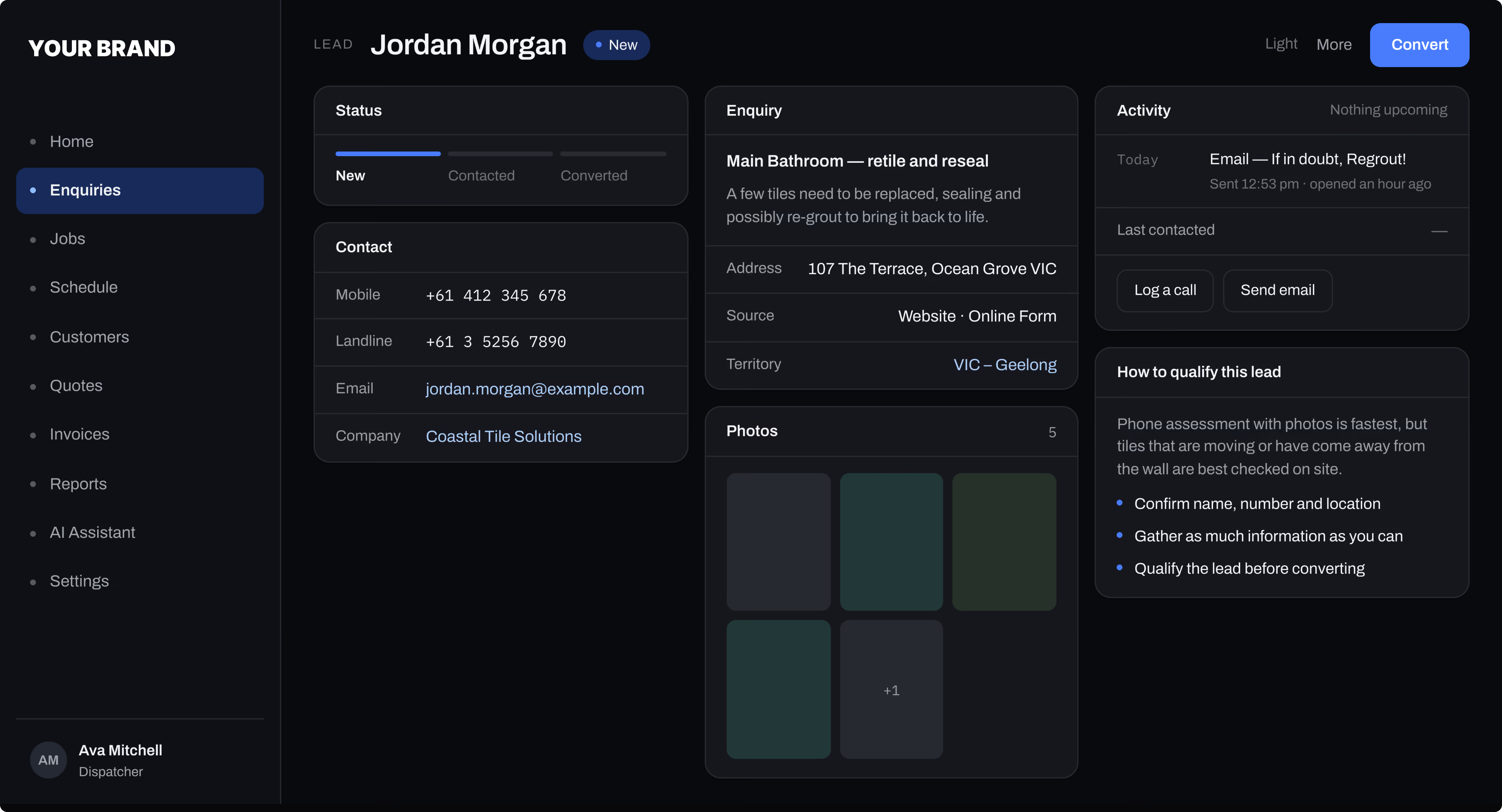
- Lead conversion improved by 20%, largely because AI agents qualify inbound enquiries and images immediately rather than waiting for a human to get to them.
- Manual work-order entry dropped from roughly two business days to about 15 seconds, through AI-powered PDF parsing that eliminates one of the most tedious, error-prone admin tasks in the business.
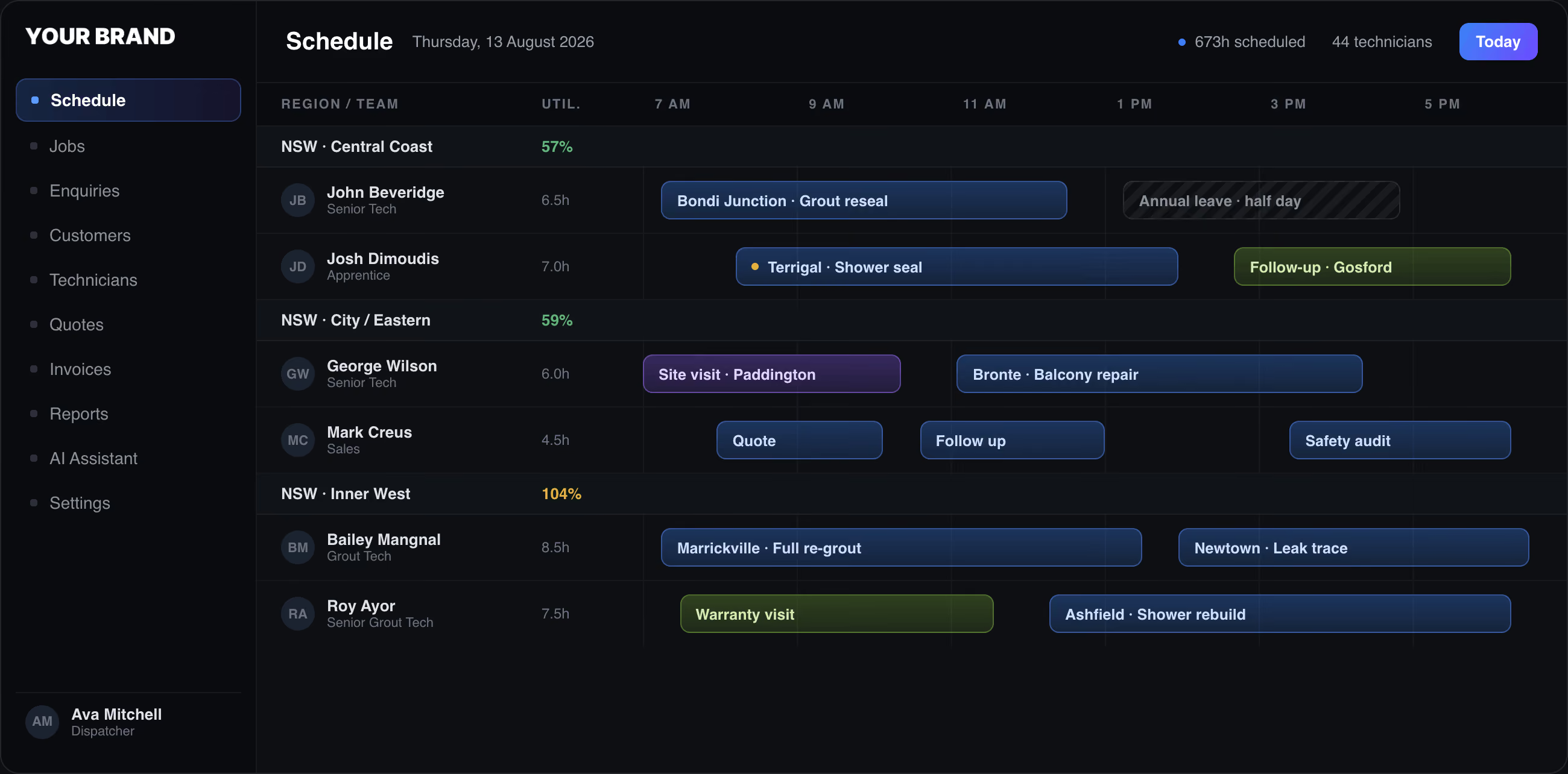
- A scheduling agent — among the first of its kind in the Southern Hemisphere — automatically fills calendar gaps and optimises travel routes in real time, rather than a dispatcher manually slotting jobs in as they come.
- By the time a technician arrives on site, they've already received an AI-generated summary of the customer's history. The job of the field team shifts back toward the actual craft, and away from chasing paperwork.
Why this matters beyond one business
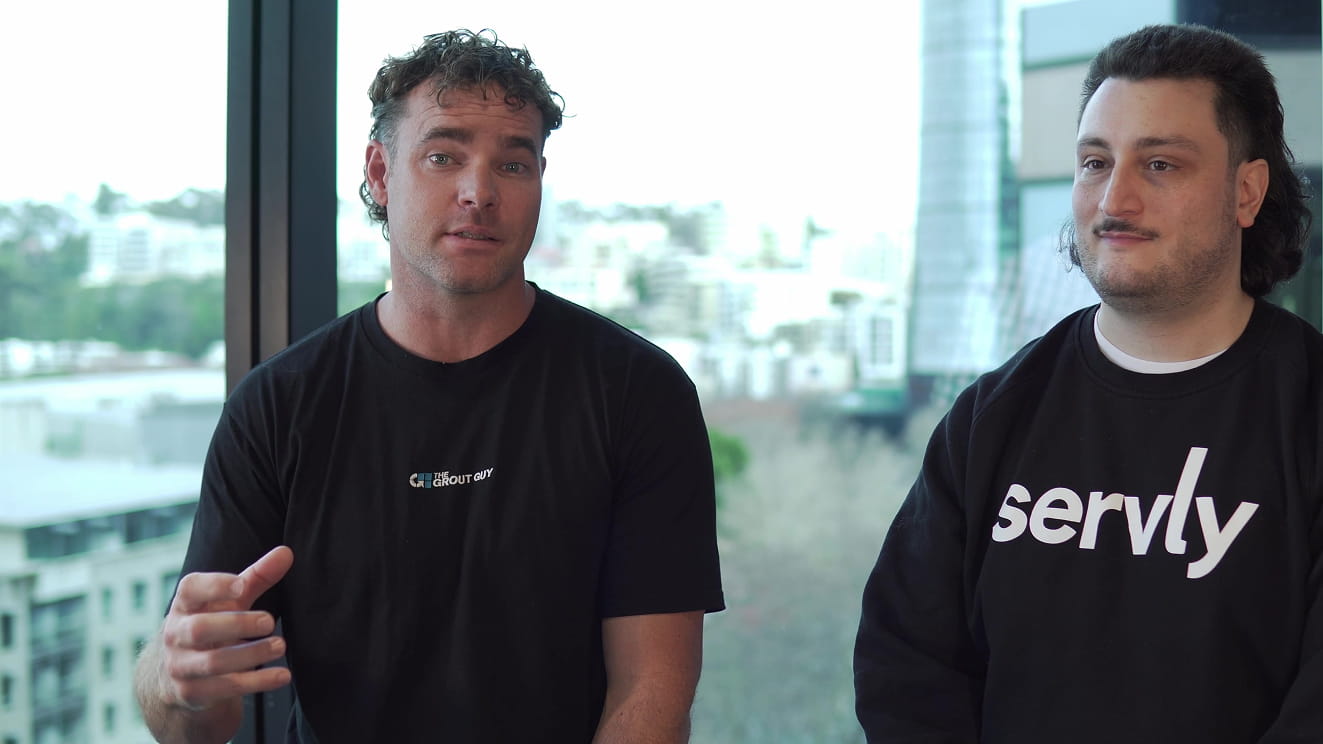
"The reality is that many trade businesses are scared off by the cost and complexity of these tools, so they stay stuck in spreadsheets," says Anthony Messina, CTO of The Grout Guy and co-founder of Servly. "We've spent the time to make this work for our own business, and now we've built it so others can just switch it on."
That's the gap Servly exists to close. Enterprise-grade AI and CRM tooling has historically been priced and built for businesses with the internal resources to implement and maintain it — which leaves small and medium trade businesses, the ones who'd benefit most from removing administrative bottlenecks, locked out by cost and complexity.
"We want to help other trade businesses realise they don't have to be stuck using siloed systems that don't support the growth they want," says Brad Young, co-founder of Servly and chief grout officer at The Grout Guy. "We're proving that you can have 'grown-up' tech without the enterprise-grade complexity."
What this looks like for a business earlier in the growth curve
Not every trade business is running 150+ technicians, and the point isn't that every business needs the full scope of what The Grout Guy has built. It's that the same structural problem — administrative load scaling faster than the team that has to carry it — shows up well before a business gets anywhere near that size.
A two-person operation missing calls on-site, a ten-technician business where the owner is still doing dispatch from a ute at lunchtime, a twenty-person team drowning in work-order paperwork — the shape of the problem is identical. What changes is just how much of it there is.
"Every lead matters, but when you're busy on site, you can't always answer the phone or qualify a photo of a leaking shower," says Young. "Our AI agents are first to the party. They handle the triage, the scheduling, and the follow-ups so the humans can focus on the craft."
The shift already underway
The businesses that get ahead of this aren't necessarily the biggest ones — they're the ones that stop treating administrative overhead as an inevitable cost of growth. AI agents handling triage, scheduling, and paperwork isn't a future state; it's already running, at scale, inside an Australian trades business today.
Servly brings the same AI and Salesforce platform behind The Grout Guy's transformation to trade businesses across Australia — built and battle-tested on a real operation, not a theoretical one. Get in touch to see what an agentic approach could look like for your business.
Explore more blogs