Salesforce for field service businesses: what Australian operators need to know

Why this question keeps coming up
Most Australian field service businesses we speak to are not asking whether software will help — they have outgrown their current stack and they know it. The harder question is whether Salesforce is the right answer, or whether a lighter job management tool will do the job for less money and less risk.
Salesforce sales conversations rarely give you a clean answer. The platform is genuinely powerful, but it is also genuinely expensive and genuinely complex to implement well. The wrong fit is one of the most expensive mistakes a growing trades or services business can make.
This post is the honest version of the conversation — written from inside a field service business that actually runs Salesforce day to day.
Is Salesforce suitable for field service?
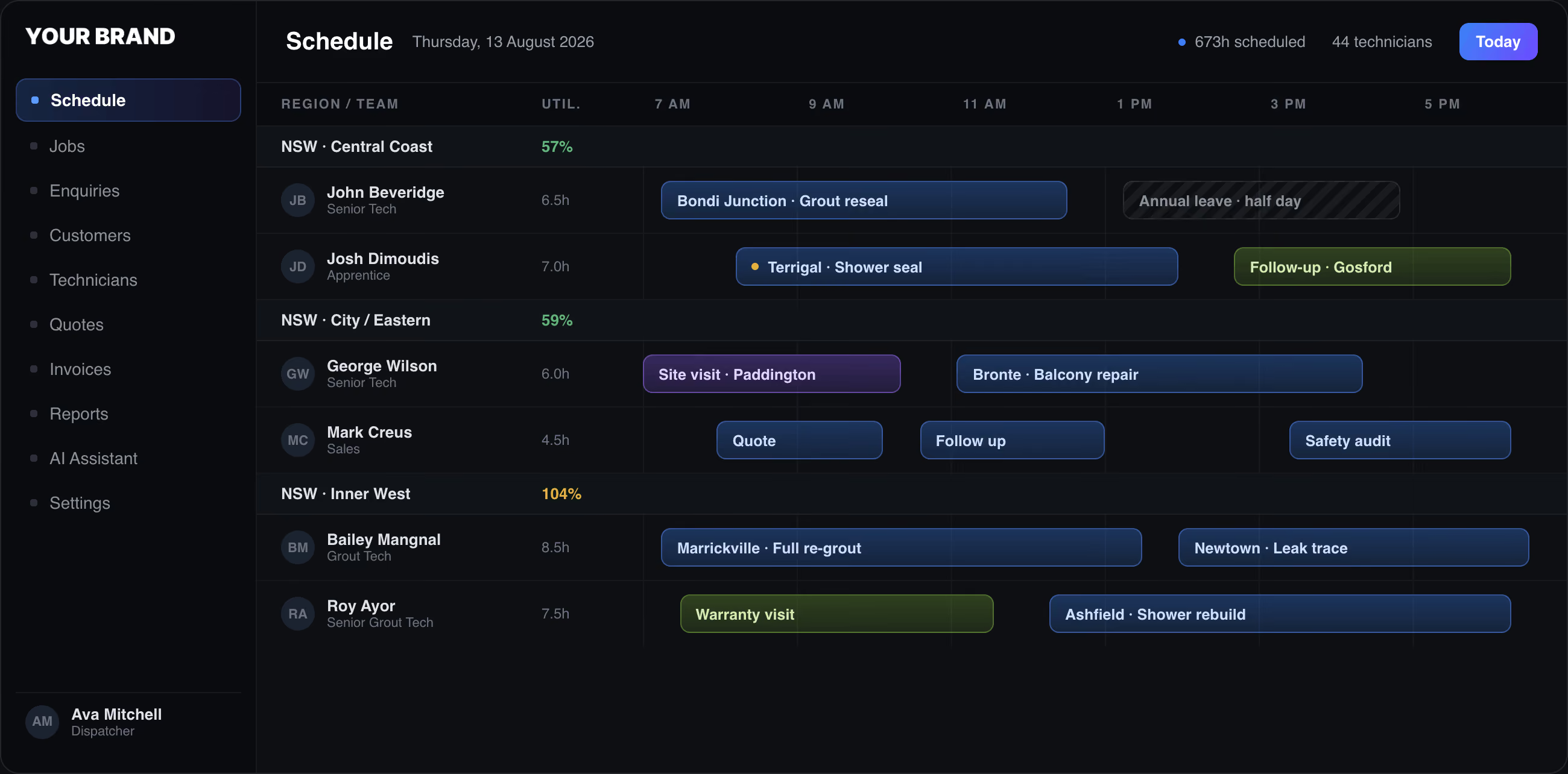
Yes — and no. Salesforce Field Service is one of the most capable platforms in the world for scheduling, dispatch, mobile work, asset management, and customer service. But "capable" is not the same as "right for you."
Suitability comes down to a handful of factors:
- Number of field technicians
- Scheduling complexity (recurring work, SLAs, skills-based routing)
- Multi-location or multi-entity operations
- Franchise networks
- Reporting and board-level visibility requirements
- Integration needs (accounting, ERP, telematics, IoT)
- Growth plans over the next 3–5 years
If you have under 10 field staff, a single location, and simple scheduling — Salesforce is probably overkill. Tools like ServiceM8, simPRO, or AroFlo will get you live faster and cost less to run.
If you are scaling past 20–30 field staff, running multiple entities or regions, or trying to consolidate three or four disconnected systems into one platform — Salesforce starts to make a lot more sense.
How much does Salesforce actually cost in Australia?
There is no single answer, and anyone giving you one is selling you something. Real total cost of ownership depends on:
- Edition — Enterprise vs Unlimited
- User mix — full Service Cloud, Field Service, platform, contractor, or mobile-only users
- Add-ons — Agentforce, AppExchange products, sandboxes, additional storage
- Implementation — partner fees, scoping, data migration, integrations
- Ongoing admin — internal admin, support contracts, ongoing development
A useful frame: budget for the three-year cost, not the monthly subscription. Licence fees are often only part of what you will actually spend across a full implementation and the first two years of operation.
The licensing trap
Choosing the wrong licence mix is the single most expensive mistake we see. The Salesforce licence catalogue is dense, and Salesforce sales teams (understandably) tend to default to full Service Cloud licences for every user.
In reality, most field service businesses need:
- Full Service Cloud or Sales Cloud licences for office staff, dispatch, and managers
- Field Service licences for technicians using the mobile app and for dispatch scheduling
- Platform or contractor licences for adjacent users who only need limited access
Getting this mix right can cut your licence bill significantly without sacrificing any functionality. Getting it wrong locks you into a number that grows with every hire.
How long does a real implementation take?
For a single-entity Australian field service business with reasonable complexity, expect 8–16 weeks for a focused phase one. Multi-entity, franchise networks, or deep integrations push that to 6+ months.
Anything quoted under 6 weeks for a real field service rollout usually means one of three things:
- The scope has been cut so far it will not solve the actual problem
- Important work has been deferred into a costly "phase two"
- The partner has not properly scoped what your business actually does
How to evaluate a Salesforce proposal
Look beyond the headline number. The questions that matter:
- Is the licence mix right, or has everyone been quoted as a full user?
- What is actually in phase one, and what has been deferred?
- How will data migration be handled, and who owns the cleanup?
- What integrations are assumed, and which are out of scope?
- How much internal admin time will you need post go-live?
- What does year two and year three cost look like, fully loaded?
A good proposal answers all of these clearly. A bad one leaves the risk hiding in the assumptions.
Where Servly fits
Servly was built from the operational success of The Grout Guy — a real Australian field service business that uses Salesforce to run and scale every day. We are not a generalist consultancy. We are operators who have been through the same decision and the same rollout.
If you are evaluating Salesforce for a field service business, we can help you work through licensing, scope, and suitability honestly — including telling you when it is not the right answer.
Want a second opinion on a Salesforce decision? Book an assessment — independent, operator-led, no sales pitch.
Explore more blogs