The Hidden Cost of "Good Enough" Spreadsheets in a Growing Trades Business

Every trades business starts somewhere simple. A booking diary, a spreadsheet for jobs, maybe a shared calendar for the van. It works — genuinely works — for a long time, which is exactly why so few businesses ever stop to question it. Spreadsheets don't fail loudly. They fail quietly, a little more each month, until one day the business realises it's been running on duct tape for two years.
We know this pattern well, because it's exactly how we started. The Grout Guy began as one van and a diary. What we didn't understand at the time was how much the spreadsheets that replaced that diary were already costing us — not in an invoice, but in time, missed jobs, and growth we were quietly leaving on the table.
Why spreadsheets feel free, but aren't
A spreadsheet has no subscription cost, no training requirement, no vendor to negotiate with. That's precisely why it's so easy to keep using one well past the point it's actually serving the business. The cost isn't in a line item — it's distributed across dozens of small frictions that never show up on a P&L:
-
Double-entry, everywhere. A job gets written in the booking spreadsheet, then re-entered into the invoicing tool, then again into whatever tracks technician pay. Each re-entry is a chance for a typo, a dropped detail, or a job that simply falls through the gap between systems.
-
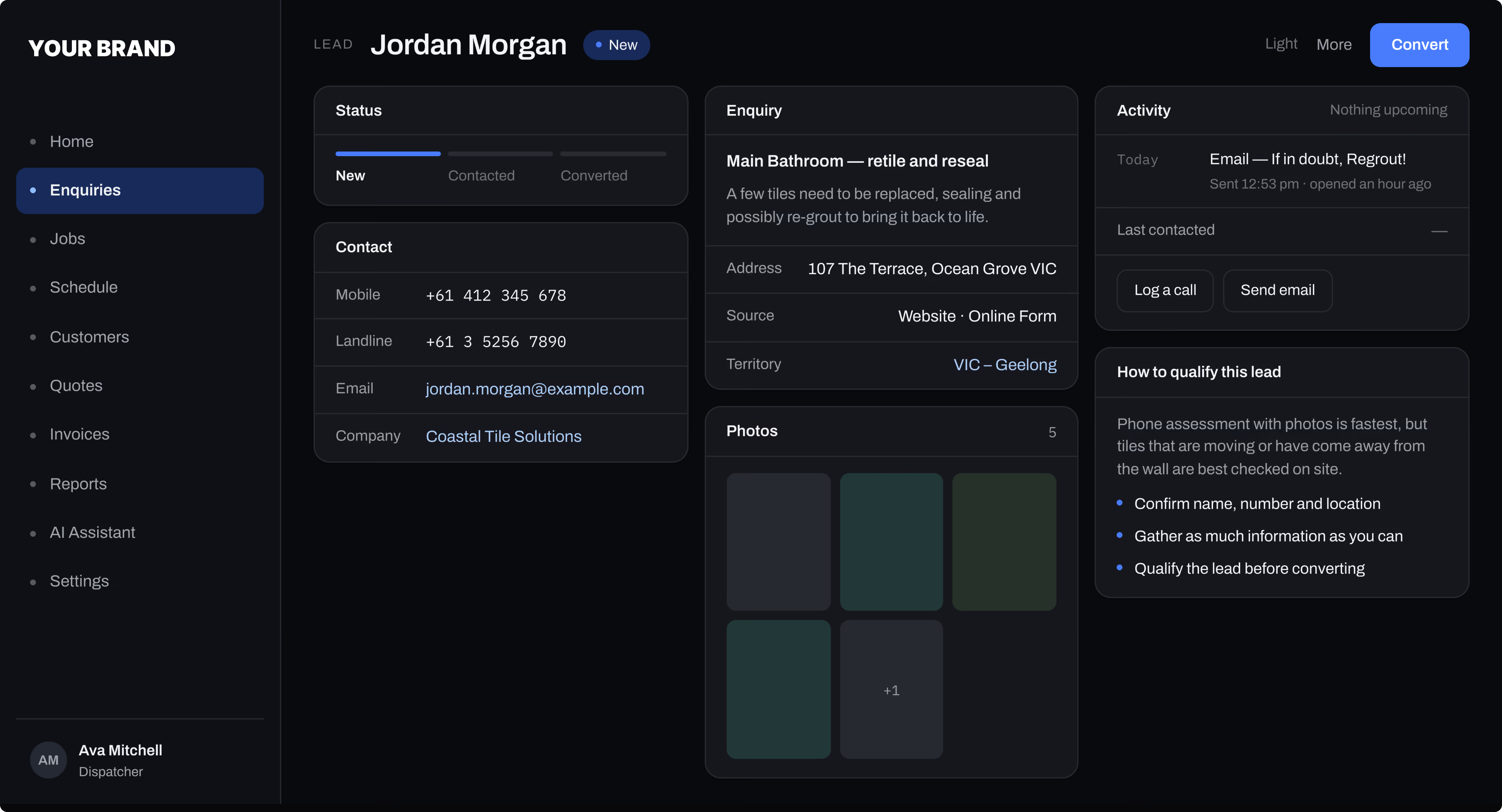
Information that only exists in one person's head — or one tab. Customer history, site access notes, which technician's actually good with a particular job type — in a spreadsheet-based operation, this kind of knowledge tends to live with whoever's been there longest, not in a place anyone can look it up. The business is quietly dependent on specific people remembering things, rather than a system holding them.
-
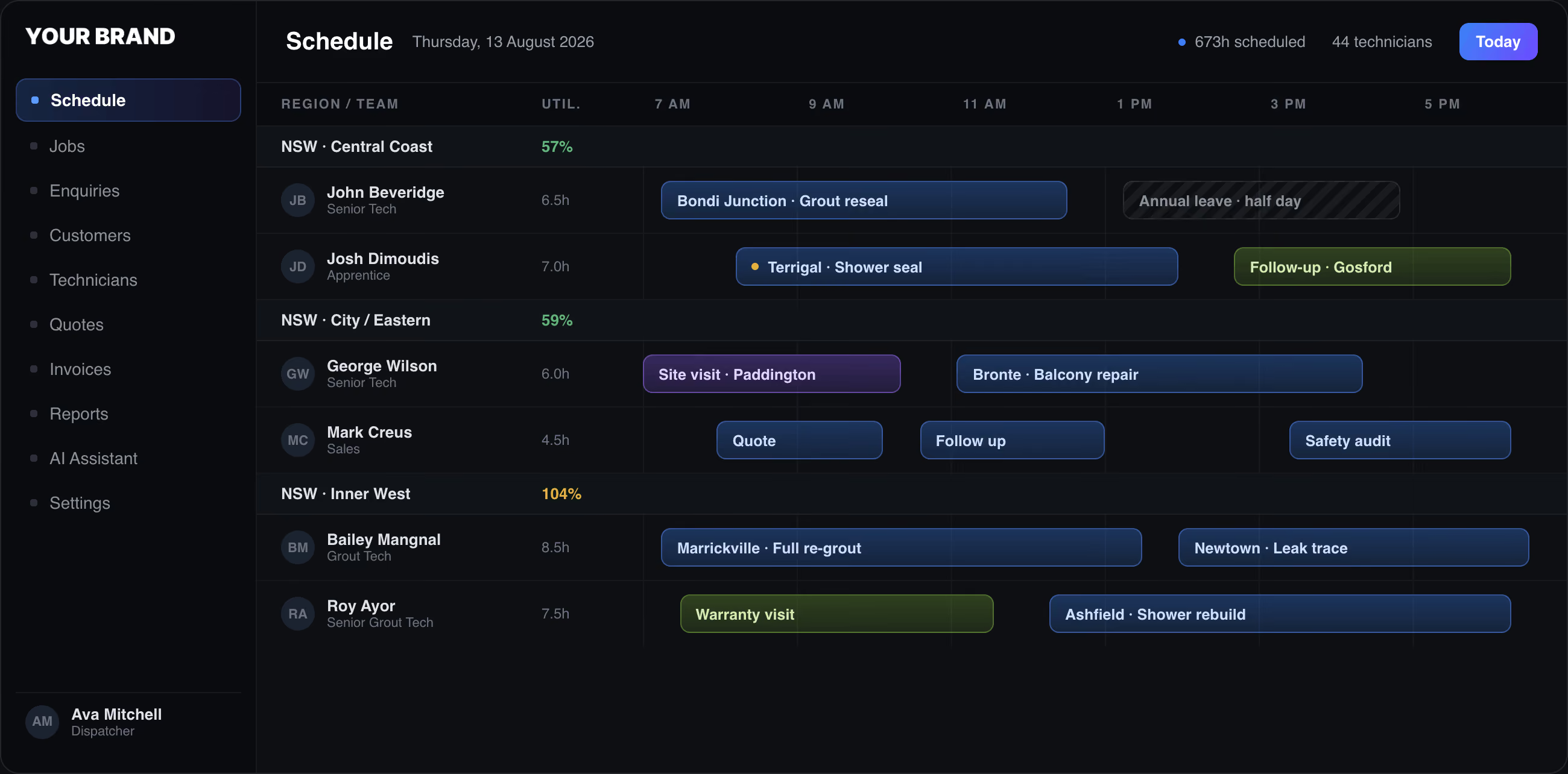
No real-time visibility. A spreadsheet tells you what was true when it was last updated, not what's true right now. Multiply that lag across a growing technician count and a dispatcher is making decisions on data that's already stale by the time they act on it.
-
A ceiling nobody sees coming until they hit it. A spreadsheet that works fine for five technicians starts creaking at fifteen and genuinely breaks somewhere past twenty-five — not because the spreadsheet got worse, but because the coordination overhead of manual systems doesn't scale linearly with headcount. It compounds.
The moment it usually gets noticed
Nobody wakes up and decides their spreadsheet has failed. It's usually a specific, uncomfortable moment: a double-booked job discovered too late, an invoice that never got sent because it fell out of the tracking sheet, a new hire who has no way to access the institutional knowledge that's only ever lived in someone else's head. Individually, each of these looks like a one-off mistake. Collectively, they're the spreadsheet system reaching its actual limit.
By the time The Grout Guy hit multi-state operations with well over a hundred field technicians, the gap between what a spreadsheet-based system could hold together and what the business actually needed had become the single biggest constraint on growth — not lead volume, not technician availability, just the sheer coordination overhead of running it all manually.
What actually changes when a business moves off spreadsheets properly
The shift isn't just "put the same information in nicer software." Done properly, it changes what the business is capable of:
- A single source of truth, so job status, technician availability, and customer history exist in one place rather than being reconciled across five
- Real-time visibility, so a dispatcher is working with what's actually true right now, not what was true this morning
- Institutional knowledge that survives staff turnover, because it lives in the system rather than in one person's memory
- Room to actually grow, because the coordination overhead stops compounding with headcount
For The Grout Guy, moving onto a properly built Salesforce platform — with AI agents eventually handling a meaningful share of lead qualification and scheduling on top of that foundation — took the business from a spreadsheet-constrained ceiling to a dispatcher-to-technician ratio of 1:25+ — up from roughly 1:4 — with the same dispatch team.
How to know if this is actually your business
A few honest questions worth asking, without an agenda either way:
- If your best dispatcher or scheduler took two weeks off unannounced, would the business run smoothly, or would things start slipping within days?
- Can a new hire find what they need to do their job without asking someone who's been there for years?
- Has a job, invoice, or customer detail ever fallen through the gap between two different spreadsheets or tools?
- Is the business's growth currently limited by demand, or by how much manual coordination the office team can physically hold together?
If most of the answers are uncomfortable, that's not a failure — it's just the normal, unremarkable point every growing trades business reaches eventually. The only real mistake is staying there longer than the business can actually afford to.
Servly builds Salesforce-based field service platforms for Australian trades businesses, starting from the same spreadsheet-and-diary point The Grout Guy started from. Get in touch if you're not sure whether you've hit that ceiling yet — we can usually tell pretty quickly.
Explore more blogs