What 150 Technicians Taught Us About Dispatcher-to-Technician Ratios
If you run a field service business, there is a number that tells you more about your operation than almost anything else on your P&L: how many technicians a single dispatcher can actually run.
Most trades businesses do not track it. The ones that do are usually running somewhere between 1:8 and 1:12 — one dispatcher juggling eight to twelve technicians before the wheels start coming off. Missed jobs. Double-bookings. Technicians sitting on hold waiting for their next allocation. Customers chasing updates nobody has time to give them.
The Grout Guy, the business Servly was built from, runs at 1:25+.
That is not a marketing number. It is the actual ratio inside The Grout Guy, Australia's largest tile and grout restoration network, across 150+ field technicians in six states. Servly was built from the platform behind that result — and because The Grout Guy is where Servly's operating model was born, this is not a case study we did once and moved on from. It is a system we still run and refine every day.
Why the ratio breaks in the first place
Dispatching does not fail because people are not working hard enough. It fails because of three structural problems that show up as a business scales:
- Manual triage does not scale linearly. A dispatcher matching jobs to technicians by skill, location, and availability can hold maybe a dozen moving parts in their head at once. Add more technicians and the cognitive load does not grow with it — it compounds. Every extra technician adds more possible combinations, not just one more name on a list.
- Lead qualification eats dispatcher time it should not. In a lot of trades businesses, the same person fielding inbound enquiries is also trying to schedule jobs. Every unqualified lead, every "just checking prices" call, every back-and-forth to nail down a job type is time not spent on the schedule.
- There is no single source of truth. Jobs tracked in one system, technician availability in a spreadsheet, customer history in someone's inbox — dispatchers spend as much time reconciling information as they do making decisions with it.
Fix those three things properly and the ratio a dispatcher can handle changes completely.
What actually changed for The Grout Guy
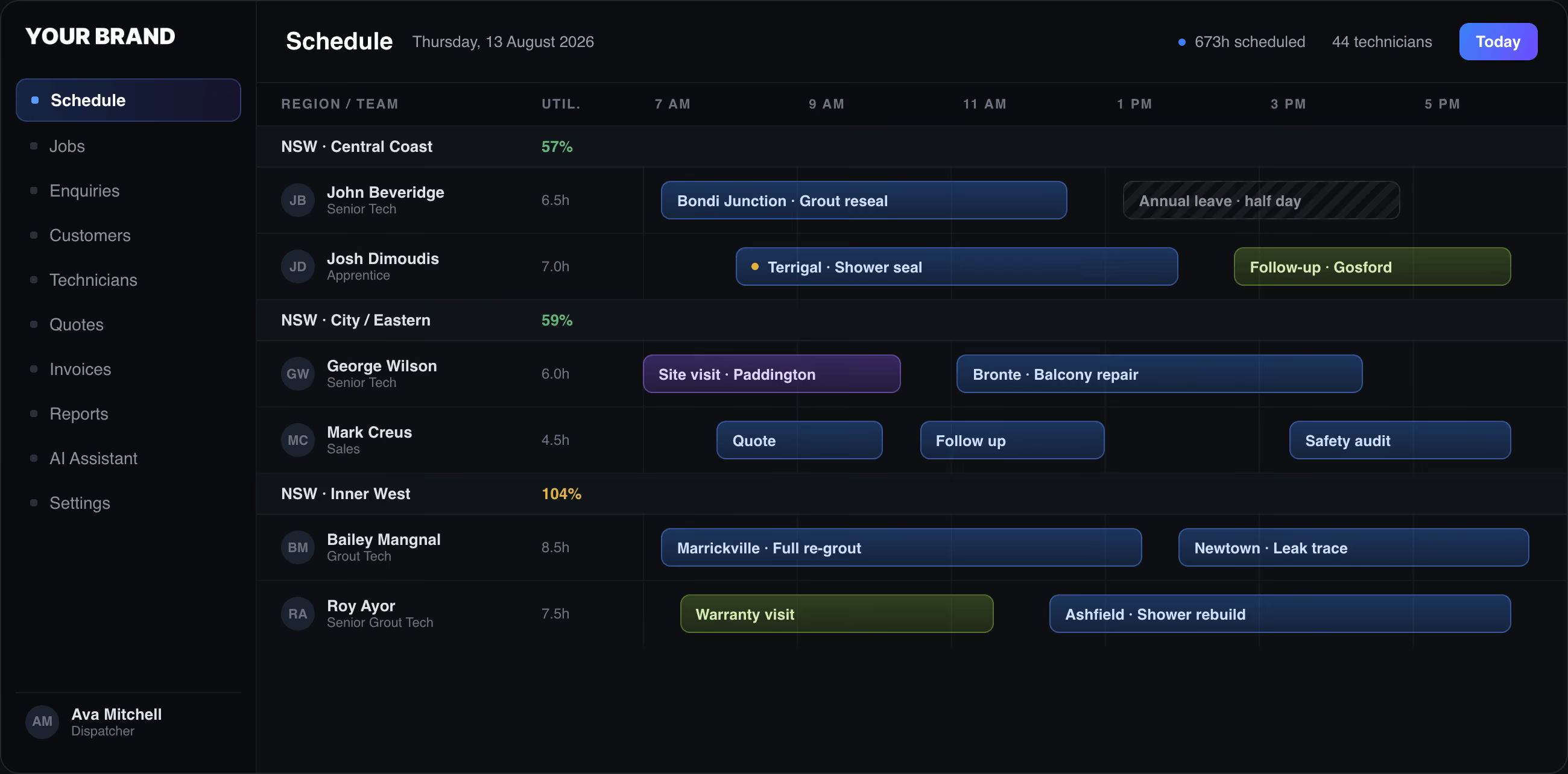
The shift from a low-single-digit ratio to 1:25+ was not one tool bolted onto an existing process. The operating layer itself was rebuilt, on Salesforce Field Service Lightning (FSL), with an AI layer sitting in front of it.
A few specific changes did most of the work:
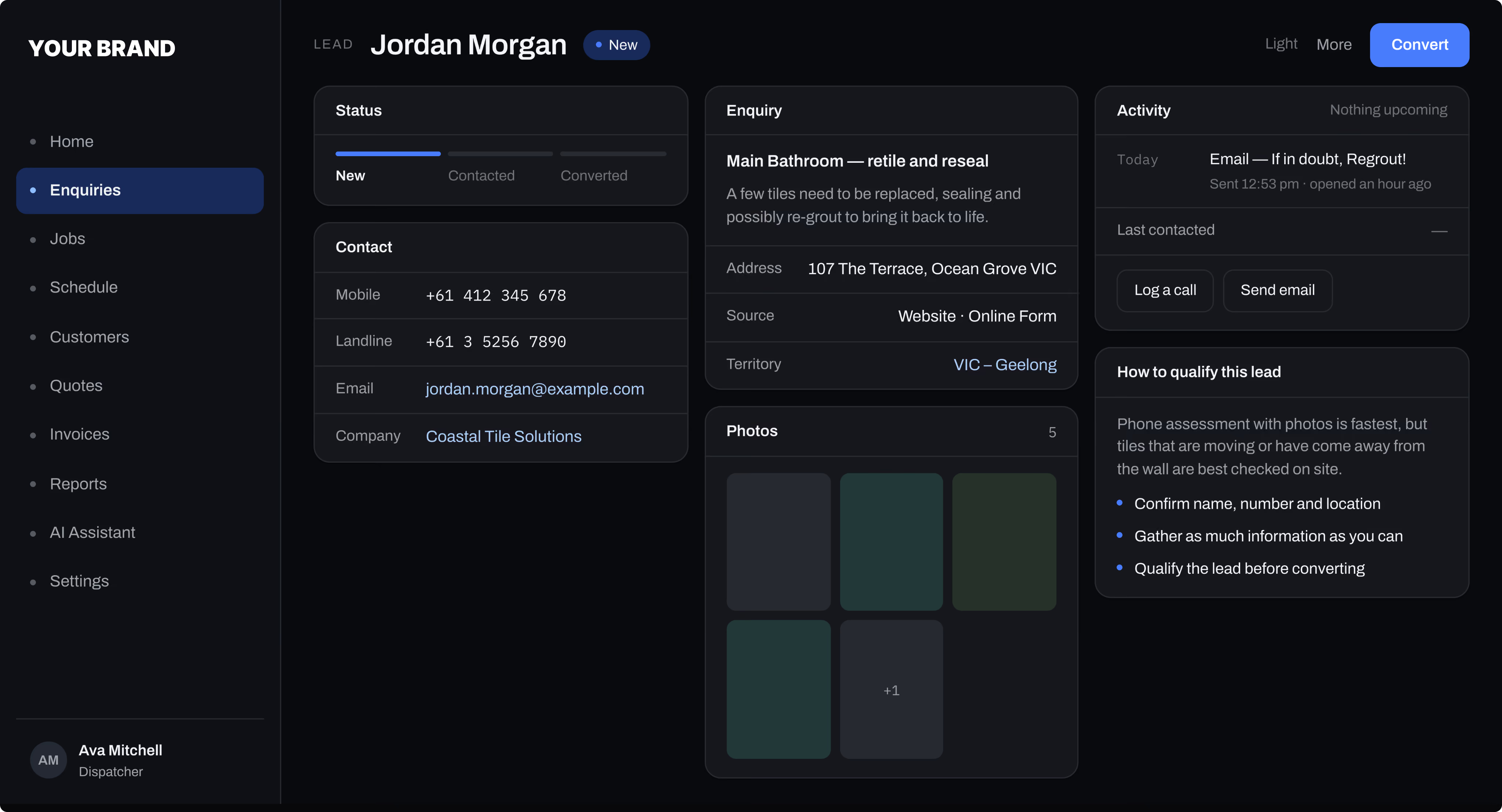
- AI-led lead qualification and booking. The Grout Guy's lead-handling agent, Groutie, now qualifies inbound enquiries at an 85%+ rate — answering FAQs and booking jobs directly into the schedule without a human touching it. That is not replacing a dispatcher's judgment on complex jobs; it is removing the volume of simple ones that should not have needed a human in the first place.
- A single scheduling and data layer. FSL became the one place job status, technician availability, and customer history actually lived — no reconciling between systems before a decision could be made.
- Automated routing and optimisation, so the dispatcher's job shifted from manual matching to managing exceptions — the jobs that genuinely need a human decision.
The result: quote turnaround dropped to roughly 30 minutes, and the same dispatch team went from being stretched thin to running a much larger technician base with headroom to spare.
Why this matters more than most trades businesses realise
A dispatcher-to-technician ratio is not just an efficiency stat. It is a ceiling on how fast a business can grow without adding headcount, and a leading indicator of how much operational chaos is quietly costing it in missed jobs, slow quotes, and technician downtime.
Most businesses only notice the ratio is broken once it is already causing visible problems — a customer complaint, a technician quitting over disorganised scheduling, a dispatcher burning out. By then it is a lot more expensive to fix than if it had been designed for properly from the start.
The Grout Guy did not set out to hit 1:25+ as a target. It is what happens once qualification, scheduling, and data live in one properly built system instead of being held together by manual effort — and it is the approach Servly is built on.
Where to start if your ratio looks nothing like this
You do not need 150 technicians for this to matter — the same three failure points (manual triage, lead qualification eating dispatcher time, fragmented systems) show up at 15 technicians just as much as 150. The fix scales down the same way it scales up.
If you are not sure what your own ratio actually is, that is usually the first sign it is worth finding out.
Servly builds Salesforce-based field service platforms for Australian trades businesses. The Grout Guy is where this was built and proven — the ratio, the numbers, and the approach above all come from a system we run live, not a pitch deck. Get in touch to talk through what this could look like for your business.
Explore more blogs